
About the Essex County Register of Deeds
The Office of the Essex County Register of Deeds and Mortgages records property transactions for all 22 municipalities in the county. The Register is Juan M. Rivera, Jr., and the office sits in the Hall of Records in Newark. The office describes deeds and mortgages on file going back to 1637, which makes it a deep resource for owners, attorneys, title searchers, historians, and genealogists.
The Record Room is open to the public for research and reference. Modern records are searchable online, while older material is kept in the Public Vault. The depth of the collection, with documents reaching back to the 1600s, makes the office one of the richest property archives in the state, useful for current owners and historical research alike.
Visit the Essex County Register of Deeds and Mortgages for the office that records county land documents.
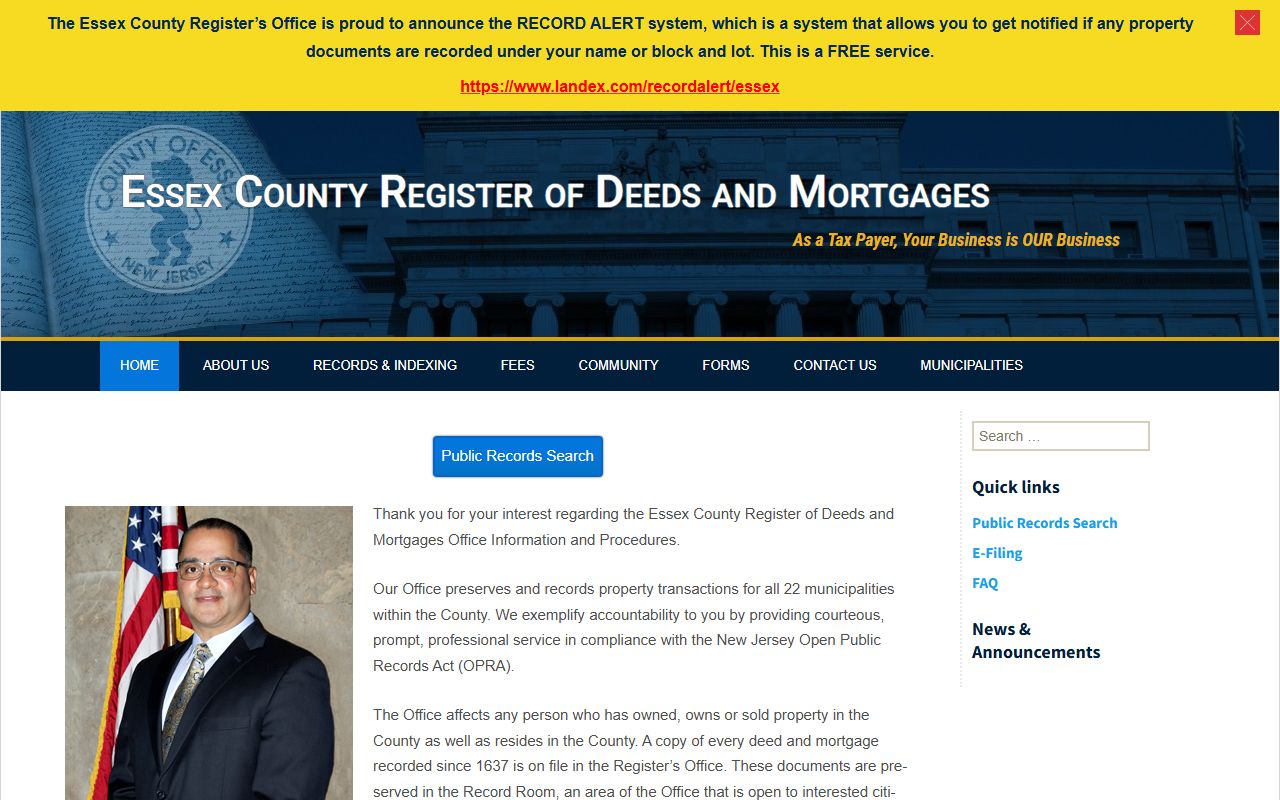
The office handles recording, preservation, and copies of property documents, separate from the courts and the County Clerk.
Essex County Register of Deeds and Mortgages
Register: Juan M. Rivera, Jr.
Hall of Records, Room 130, 465 Dr. Martin Luther King, Jr. Blvd.
Newark, NJ 07102
973-621-4960
presssupport@essexregister.com
How to Search Essex County Land Records
The Register runs an online search system called PRESS. It lets you look up land records by instrument number, book and page, document type, block and lot, or party name. The system is free for informational searches, though it is not a substitute for a professional title search.
Pick the search mode that fits what you know. An instrument number or book and page pulls a single document, while a name or block and lot search finds records tied to a person or property.
- Open the PRESS public search system.
- Choose a search mode, such as name, instrument, or block and lot.
- Select the municipality and set a date range within the 90-day limit if required.
- Review the indexed results and document types.
- Order an official copy from the Register's office when you need one.
Open the Essex PRESS land-record search to begin an Essex County land records search.
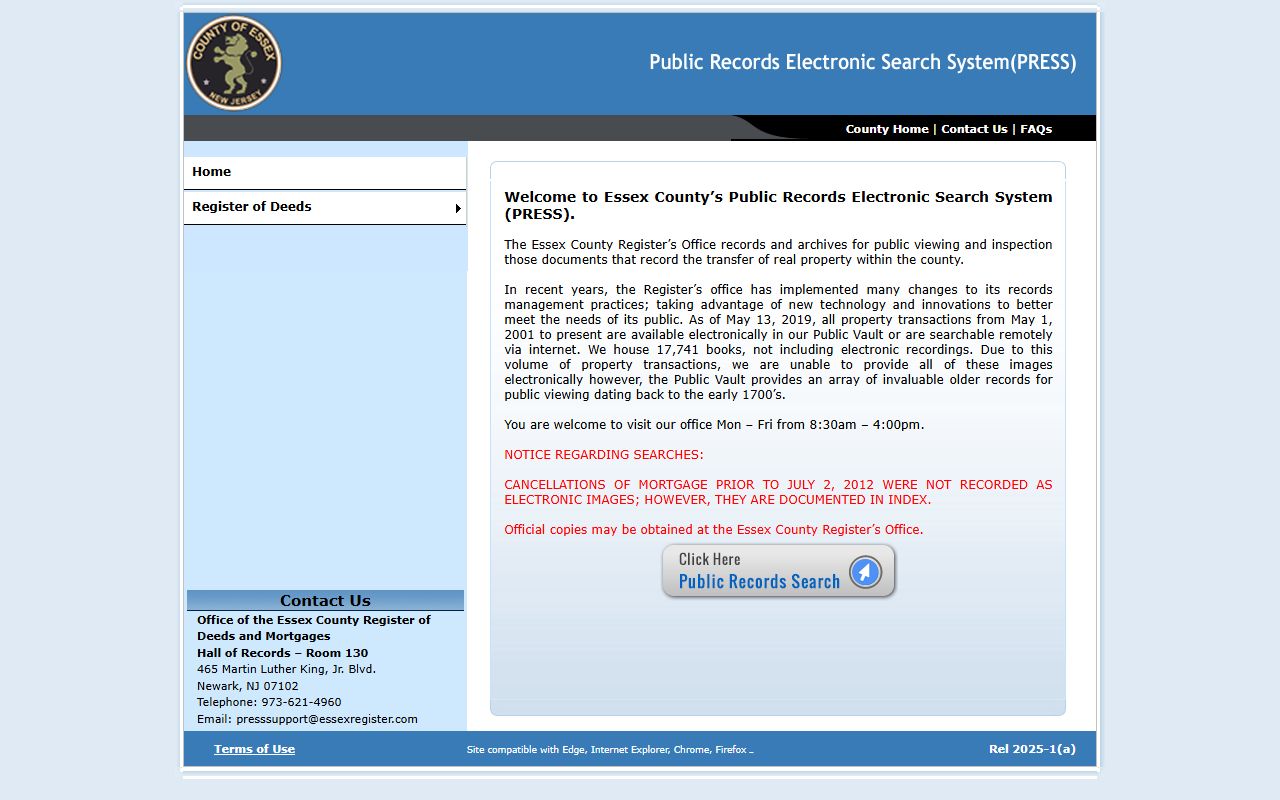
The search entry leads to the full form, where you set the search mode and filters.
PRESS Land Records Search Fields
The PRESS form supports several search modes, each with its own required fields. A name search needs a last name or company, while a document-type search needs a municipality and date range. The table lists the main fields.
| Field | Type | Required | Notes |
|---|---|---|---|
| Instrument | Text | For instrument search | Search by instrument number. |
| Book / Page | Text | Paired | Used together to find a recorded document. |
| Municipality | Dropdown | For document and block/lot search | One of the county's 22 municipalities. |
| Date Range From / To | Date | Often required | Maximum 90 days between dates. |
| Block / Lot | Text | For property search | Paired to find a parcel. |
| Last Name / Company | Text | For name search | First name is optional. |
See the PRESS searchable form for the full set of Essex County land record search options.
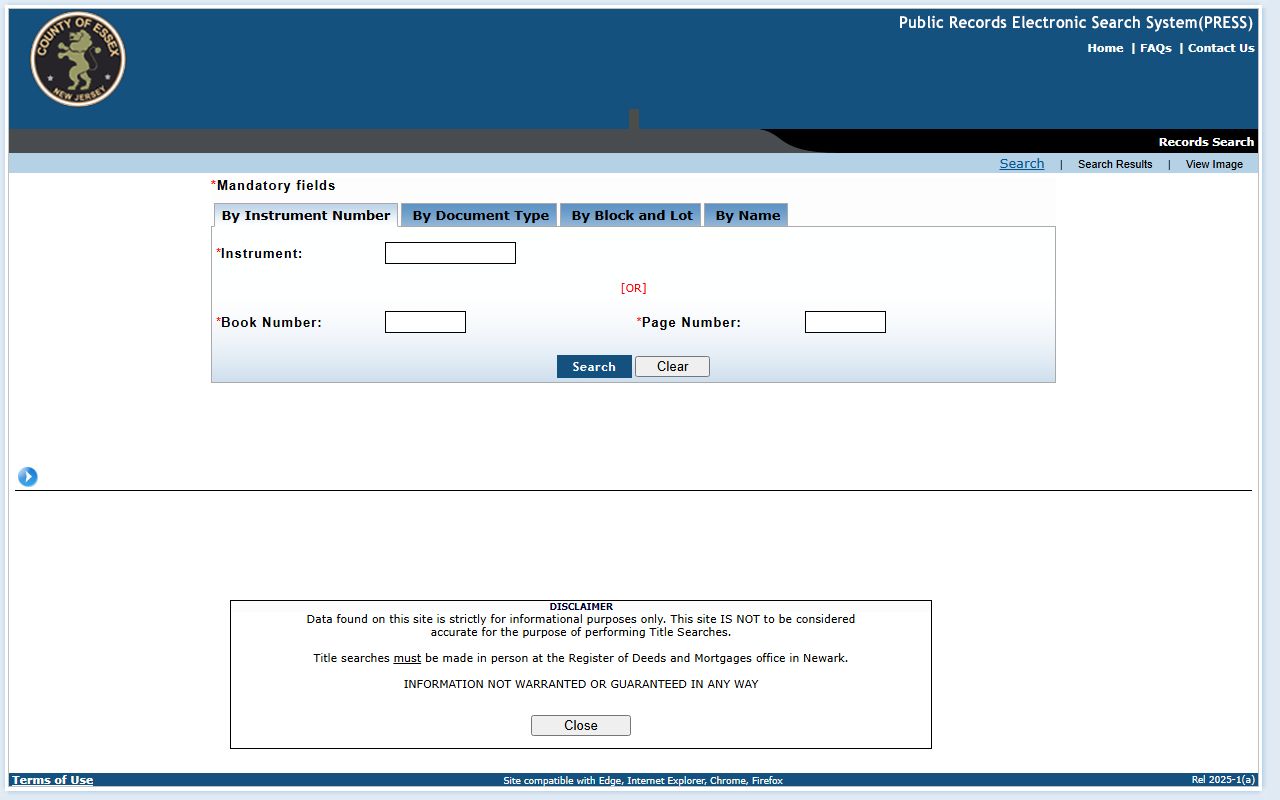
The form notes that online data is informational only and is not warranted for title searches.
What the Register Records
The Register records the documents that transfer or encumber property. That includes deeds, mortgages, and related instruments for all 22 Essex municipalities. The office also handles certain liens and recorded land documents, and it preserves the historical record of county property.
These are distinct from court records and from County Clerk services. A deed goes to the Register, a court case goes to the Superior Court, and a passport or notary oath goes to the County Clerk. This separation trips up many people, who assume one county office holds everything, when in fact the work is split among several elected officers.
- Deeds that transfer property ownership.
- Mortgages and mortgage cancellations.
- Recorded land-related liens and instruments.
- Historical property records preserved in the Public Vault.
How Property Recording Works in Essex County
Recording is the act of placing a property document into the public record. When a home sells, the deed is recorded with the Register, and when an owner borrows against a property, the mortgage is recorded too. Recording gives public notice of who owns what and which liens attach to a parcel. That public notice is the backbone of how property rights are tracked.
The Register indexes each document so it can be found later by instrument number, book and page, parties, or block and lot. When a mortgage is paid off, a cancellation or discharge is recorded to clear it. Because the office covers all 22 municipalities, a single search system reaches the entire county, which is a real convenience for owners and researchers alike. The block and lot numbers tie a document to a specific parcel, which is how the Register links many records to one piece of land over time.
Record Coverage and Sample Record
Coverage depends on the era. The PRESS form can search records from October 1996 onward, while another Register page states property transactions from May 1, 2001 to the present are available electronically. Older records reach back to the early 1700s in the Public Vault, and the office reports deeds and mortgages on file since 1637. Mortgage cancellations before July 2, 2012 are documented in the index but not as electronic images.
A typical PRESS result shows a set of fields tied to the recorded document. The list below reflects what a land record result generally includes.
- Instrument number, or book and page.
- Municipality and document type.
- Parties, such as grantor and grantee.
- Block and lot for the property.
- Recorded date and image availability.
See the PRESS register details for the office's records scope and coverage dates.
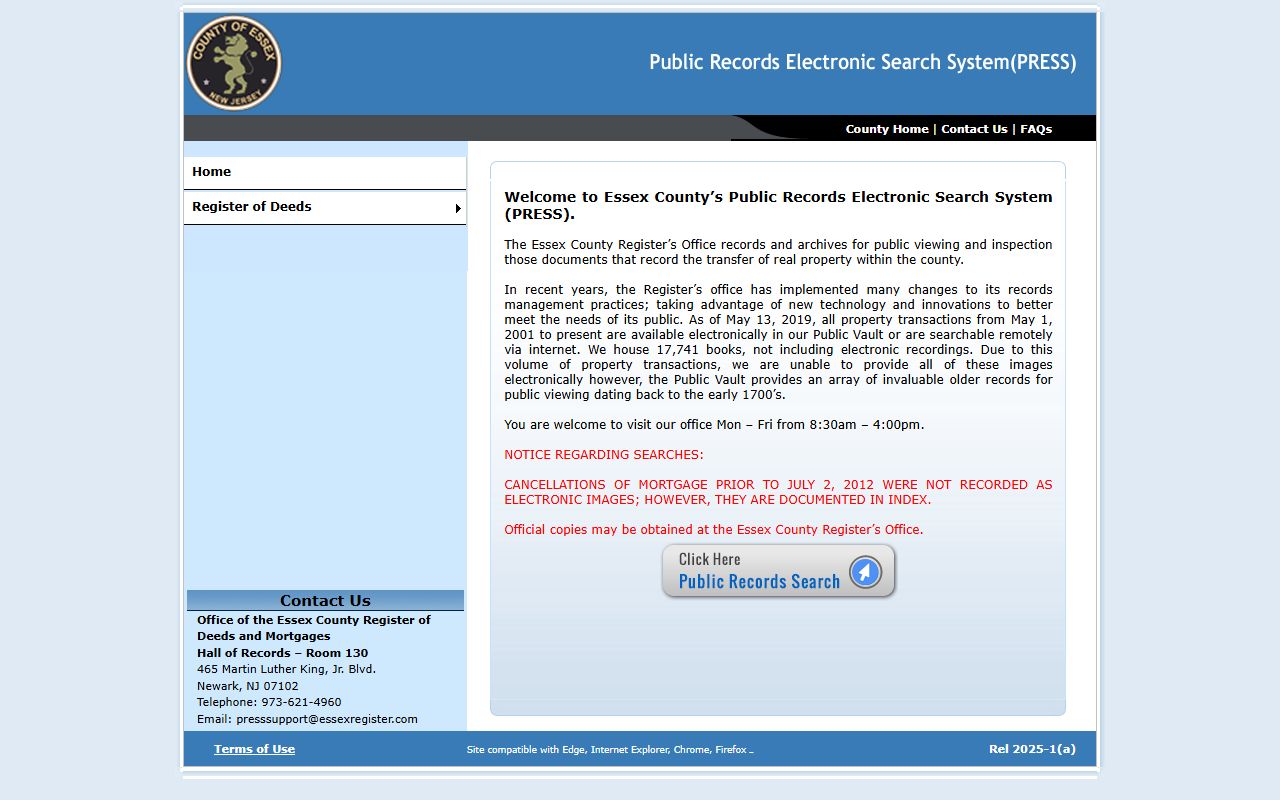
The details page also gives the office address and confirms that official copies come from the Register.
Record Alert and Fraud Protection
The Register offers a free Record Alert service through Landex. You sign up with your name or property block and lot, and the system notifies you if a document is recorded that matches. It is a simple guard against property and deed fraud.
Sign up for Essex County Record Alert to get notices when a document is recorded under your name or property.
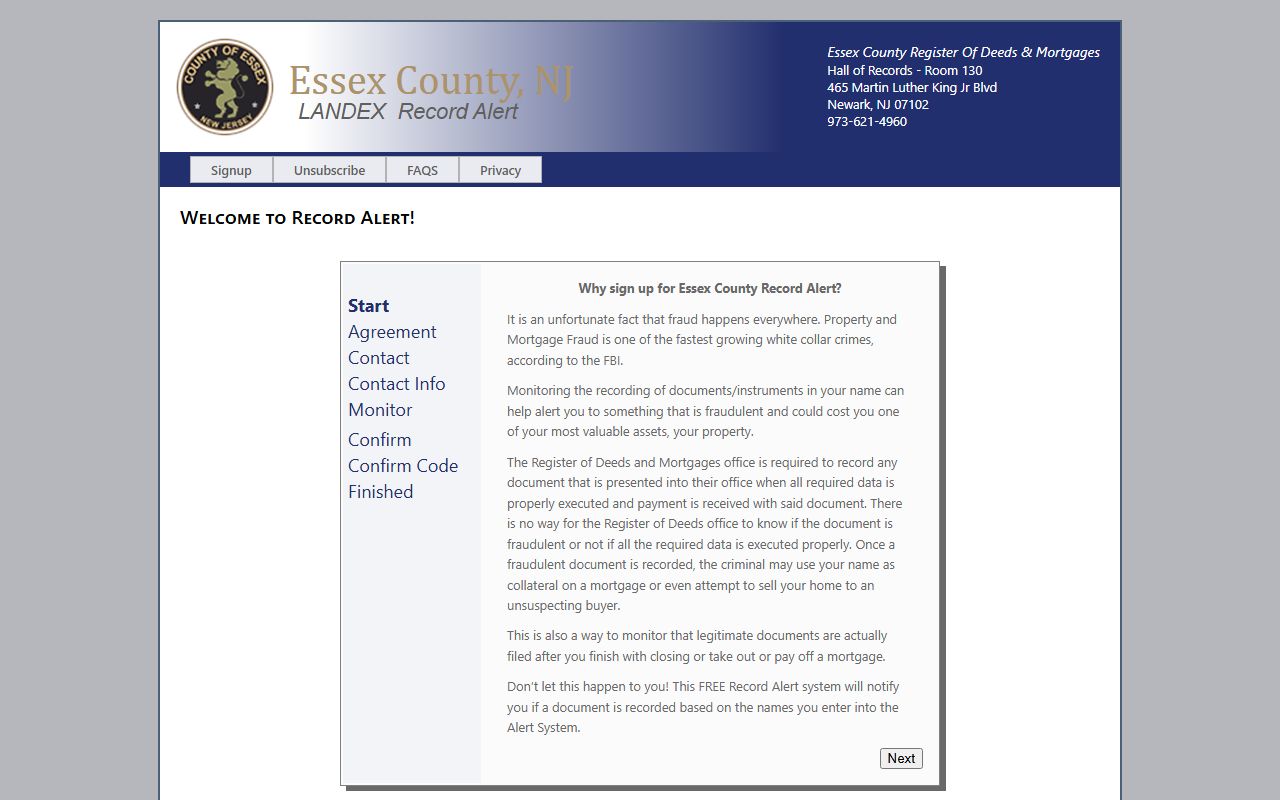
Alerts do not stop a recording, but they let you act quickly if something unexpected is filed against your property. The service is free and runs through Landex, and it is a sensible step for any owner who wants an early warning about activity on a deed or mortgage.
Title Searches and Certified Copies
PRESS is an informational tool, not a title search. The Register warns that online data is not warranted or guaranteed for title purposes and that title searches must be made in person at the Register's office in Newark. The county also does not perform title searches as a service.
Official and certified copies of recorded documents come from the Register's office. For a legally reliable picture of a property's chain of title, a professional title search at the office or through a title company is the correct route, not a quick online lookup. Buyers, lenders, and attorneys rely on that formal search before a sale closes, since a missed lien or prior claim can derail a transaction.
Note: Online PRESS data is informational only and is not a substitute for an official title search at the Register's office.
Register Fees and Requests
Some Register services carry set fees. A name list for public notices costs the greater of $0.25 per name or $10, and a municipal lien search is provided within 15 days for a $10 fee. Official copies of recorded documents are obtained from the Register's office.
For county agency records that are not land documents, an open public records request goes to the county custodian instead. Recorded liens and judgments handled by the County Clerk are a separate filing from the deeds and mortgages recorded here.
Recording fees for new documents are set by statute and depend on the document type and page count, so confirm the current schedule with the office before you file. The Register welcomes title searchers, historians, and genealogists in the Record Room, which makes the office useful well beyond a single property transaction.